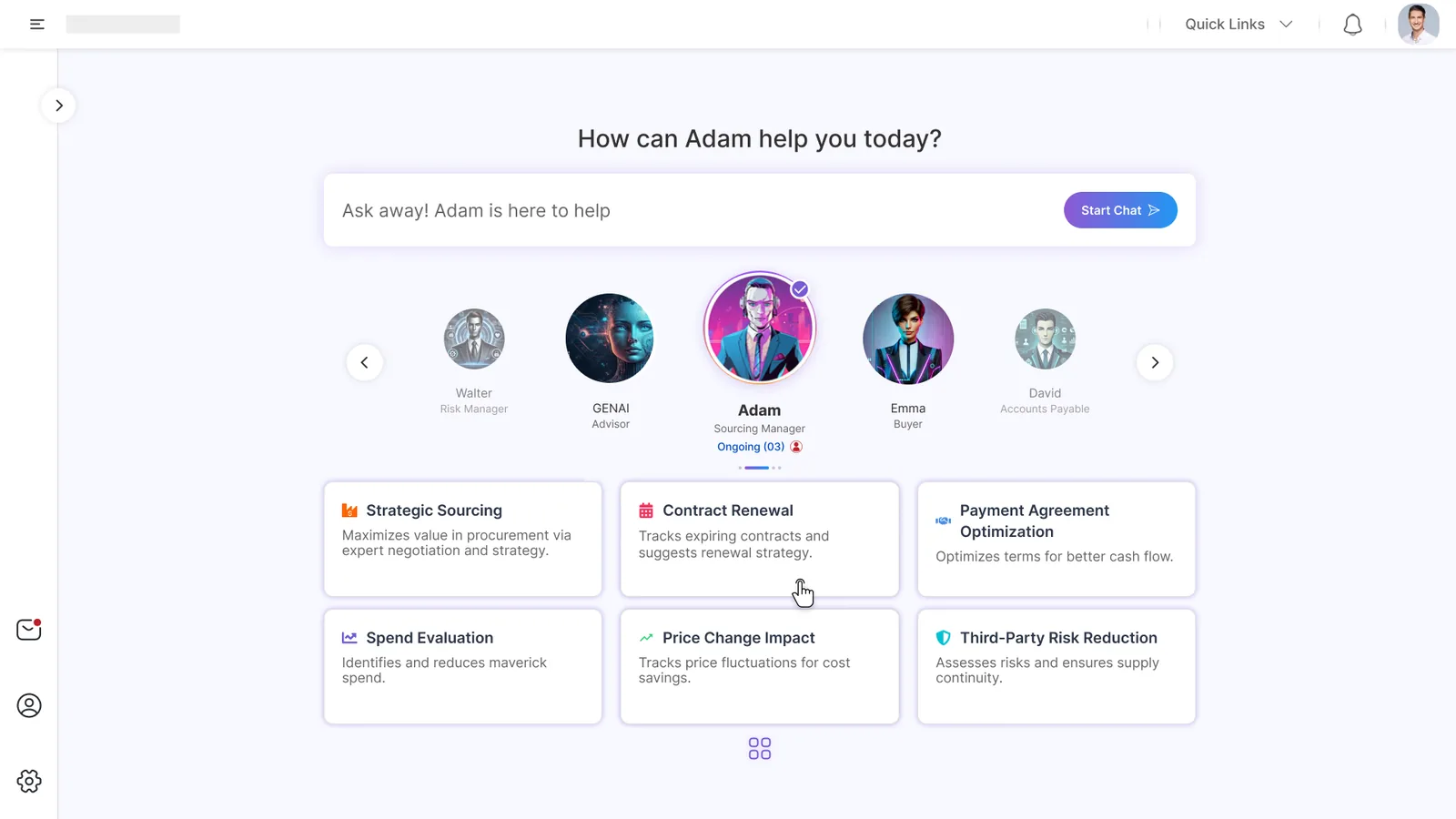
An interface layer for procurement software that decides and acts on its own — built for a function whose entire culture is approval, audit and the right to say no.
The problem was never that procurement software was ugly. It was that the people who had to raise a request would do almost anything to avoid it.
Stakeholders who find their procurement system difficult to use, learn to bypass it. They send an email. They call a colleague. They order on a corporate card and submit an expense.
Andrew Bartolini, Ardent Partners · CPO Rising, May 2026
Every one of those workarounds is spend the business never negotiated, a supplier it never rationalised, a policy it never applied. The industry calls it maverick spend. That's the commercial damage, in two words.
The cause is architectural. Enterprise procurement tools were built for the professional buyer — someone who lives in the system and has learned its vocabulary. But most requests come from someone else entirely: a marketing manager who needs catering, an engineer who needs hardware, a facilities lead who needs a valve.
That person buys something four times a year. They will never learn which form to open, which category code applies, or which approval chain their request triggers.
Procurement's value is measured by the spend it prevents. Handing decisions to software reads as a threat to the function's reason for existing — and these were the people who had to champion it internally.
Built on ChatGPT with a proprietary prompting layer. The company told analysts early versions had meaningful hallucination problems, later reduced through prompt engineering and RAG grounding. The confidence of the UI cannot exceed the confidence of the system beneath it.
A purchase requisition is a legal and financial record with mandatory fields. Chat is fluid, linear and lossy. The input is unstructured; the output has to be exact.
Adoption depended on not asking anyone to open another application. The primary surface was a chat client, with web and mobile alongside.
The agentic layer had to sit across an established suite — intake, supplier management, procurement, invoicing, spend analytics and the supplier network — without forcing a rewrite of any of them.
Approval is always a separate, explicit human act.
The obvious alternative was full automation with post-hoc review: let the agent complete the request, then show a summary and an undo. Faster, fewer taps, far more impressive in a sales demo.
It would have failed here. In procurement, an action that has already happened is an action that has already entered an audit trail. "Undo" is not a neutral affordance when the record is the point.
Five patterns carry that decision through the product. I proposed and prototyped each, and defended them through design review before they reached engineering.
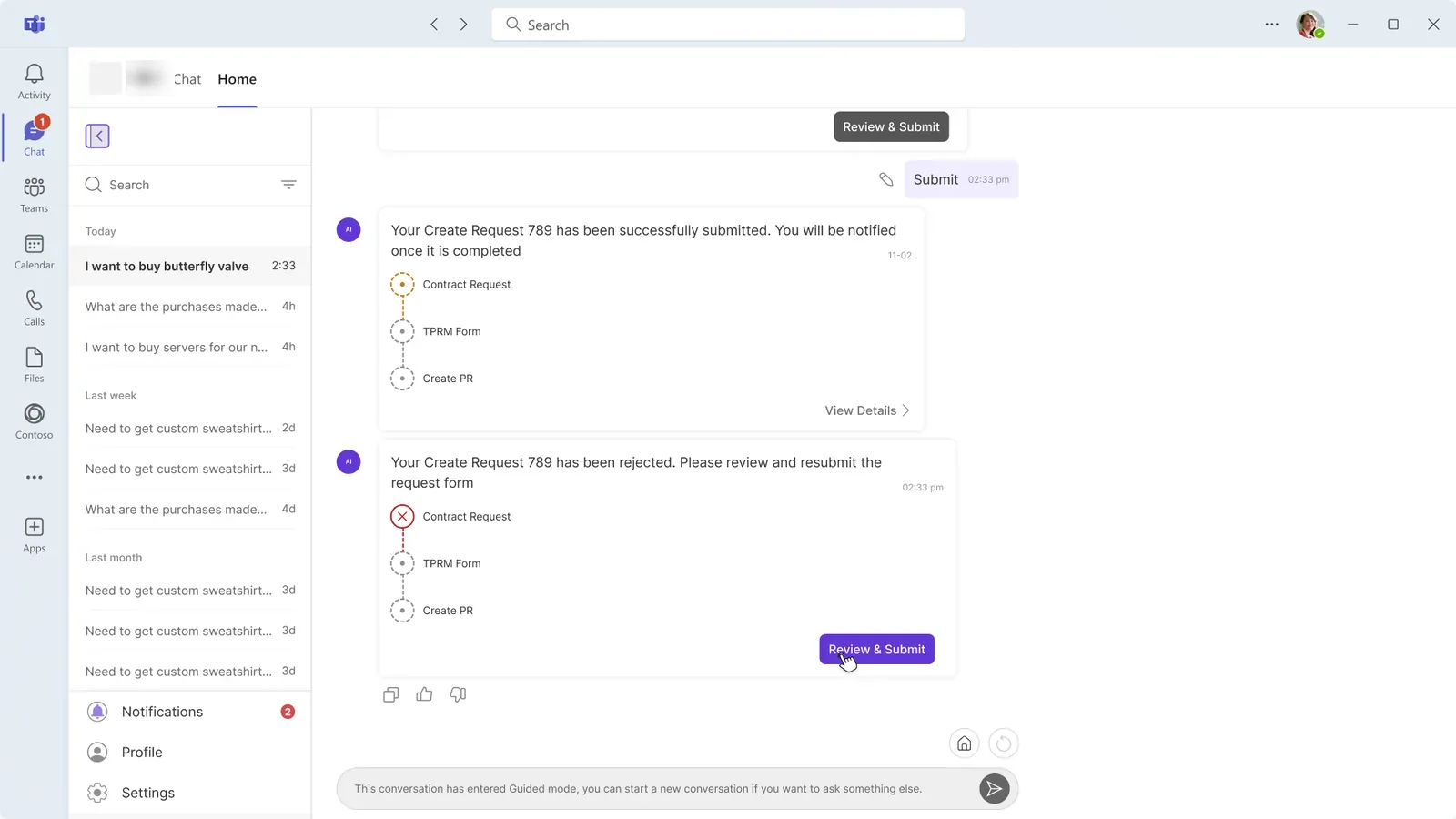
The agent assembles the request and stops. The AI does the labour; the human does the committing.
"We have a pre-filled request form drafted for you. Please review and submit."
The system, after extracting a request from natural language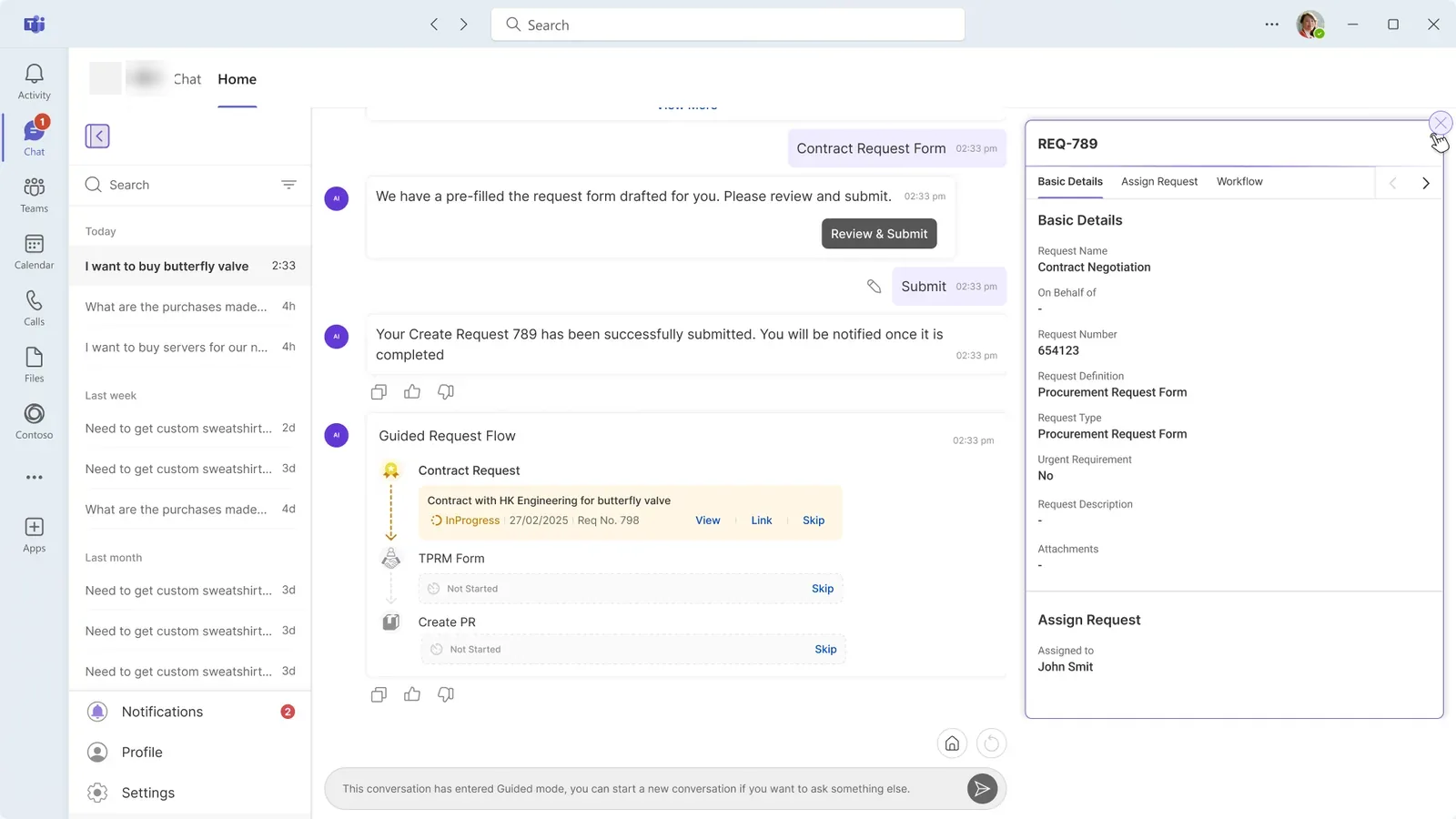
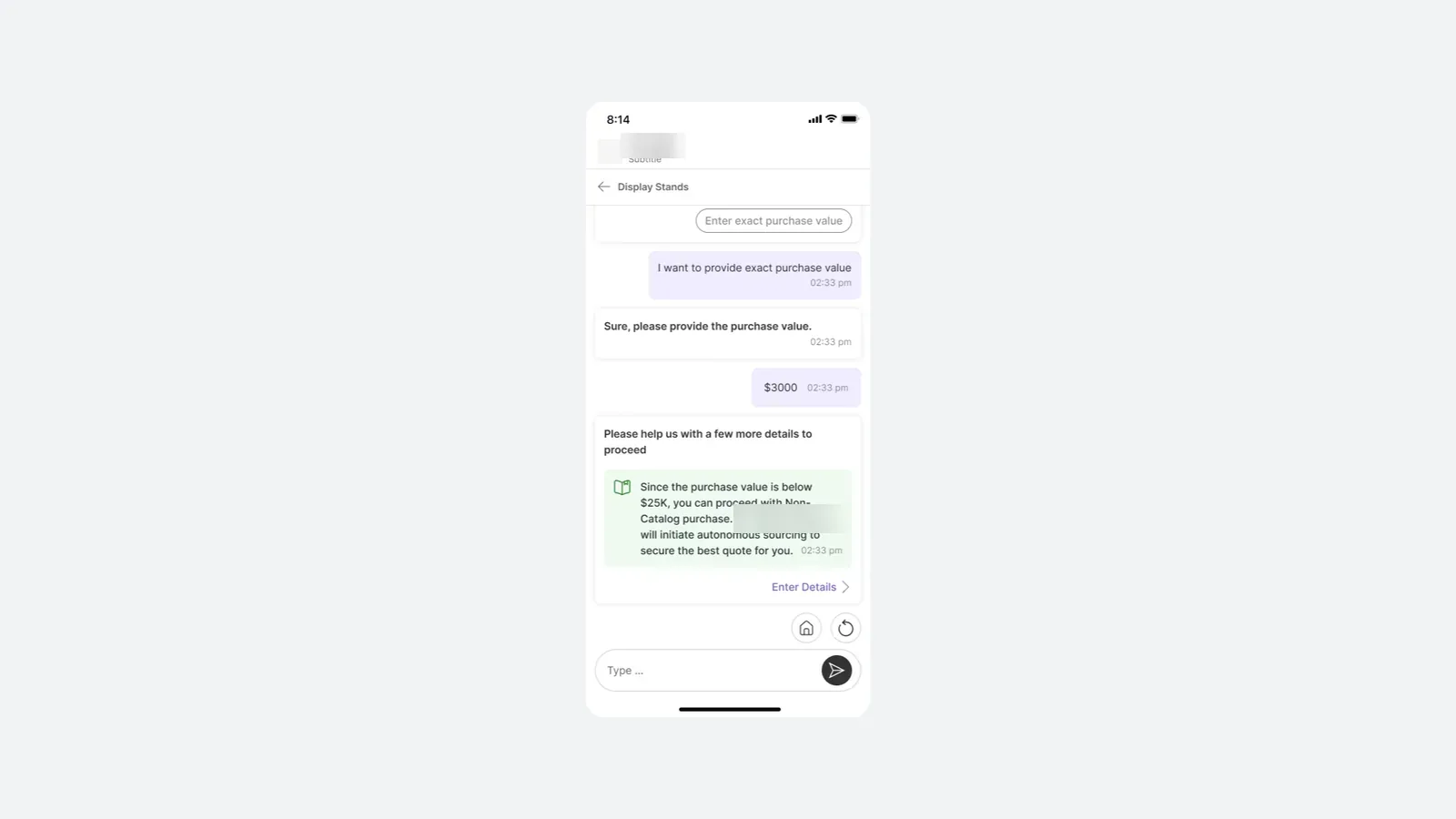
When policy routes a request, the system says why — before it happens. The user is told the threshold, the consequence, and what comes next.
"Since the purchase value is below $25K, you can proceed with Non-Catalog purchase. The system will initiate autonomous sourcing to secure the best quote for you."
Policy, explained inside the conversation rather than enforced as a blockAn independent procurement analyst reviewing the product named this its most interesting property: compliance becomes a byproduct of a good user experience, not a hurdle.
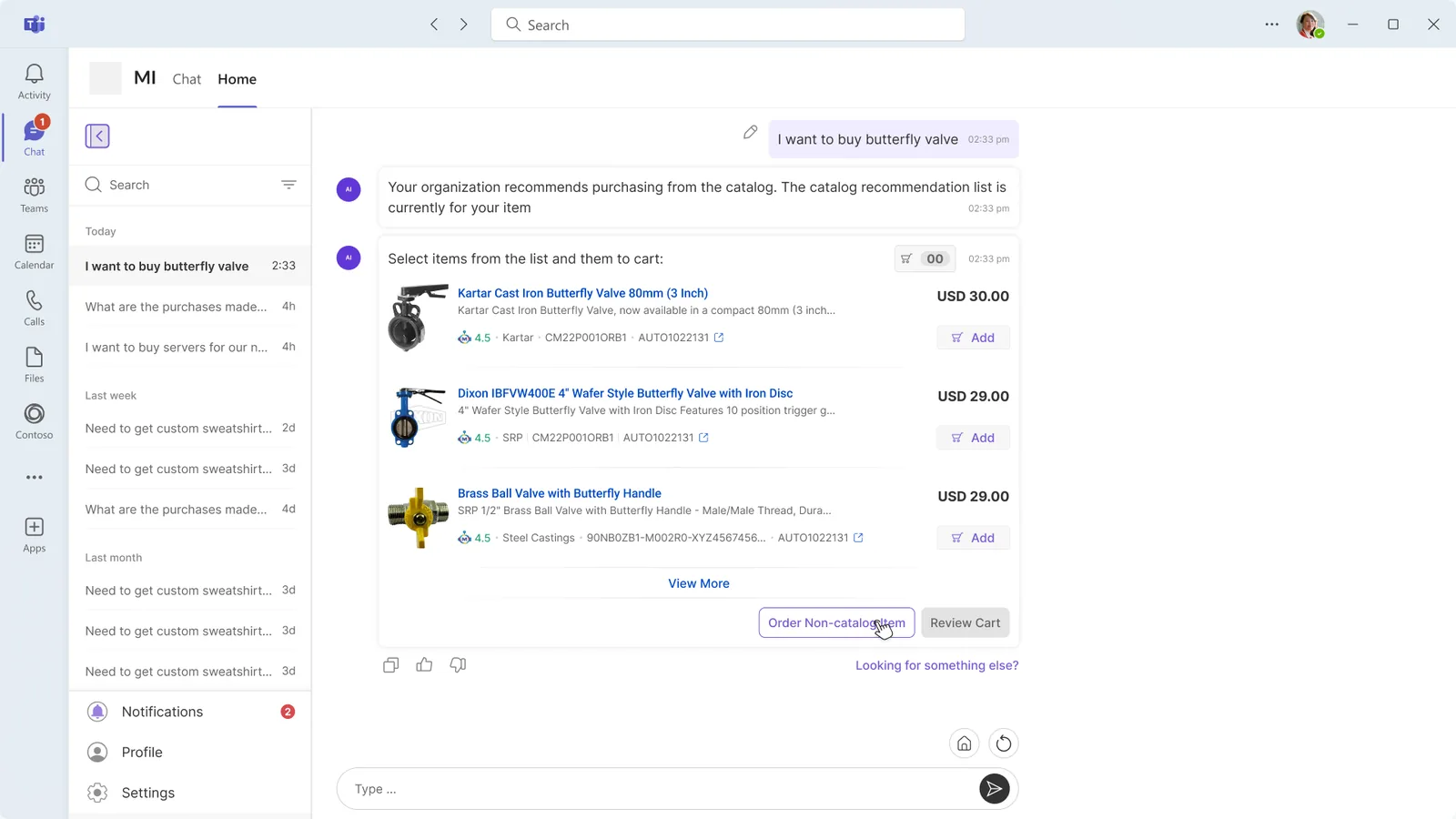
When a conversation becomes a structured multi-step flow, the input bar says so.
"This conversation has entered Guided mode. You can start a new conversation if you want to ask something else."
Mode disclosure — rare in conversational productsIt cost a small amount of friction, and it bought the thing friction is usually spent to avoid: the user always knowing where they are.
Multi-step journeys render as a persistent vertical stepper — Contract Request → TPRM Form → Create PR — with live status and an explicit Skip on every step. How many steps remain, what state each is in, and the fact that skipping is permitted rather than hidden.
In an approval-driven organisation, the failure path isn't an edge case — it's where users spend much of their time. It was designed to the same standard as the happy path.
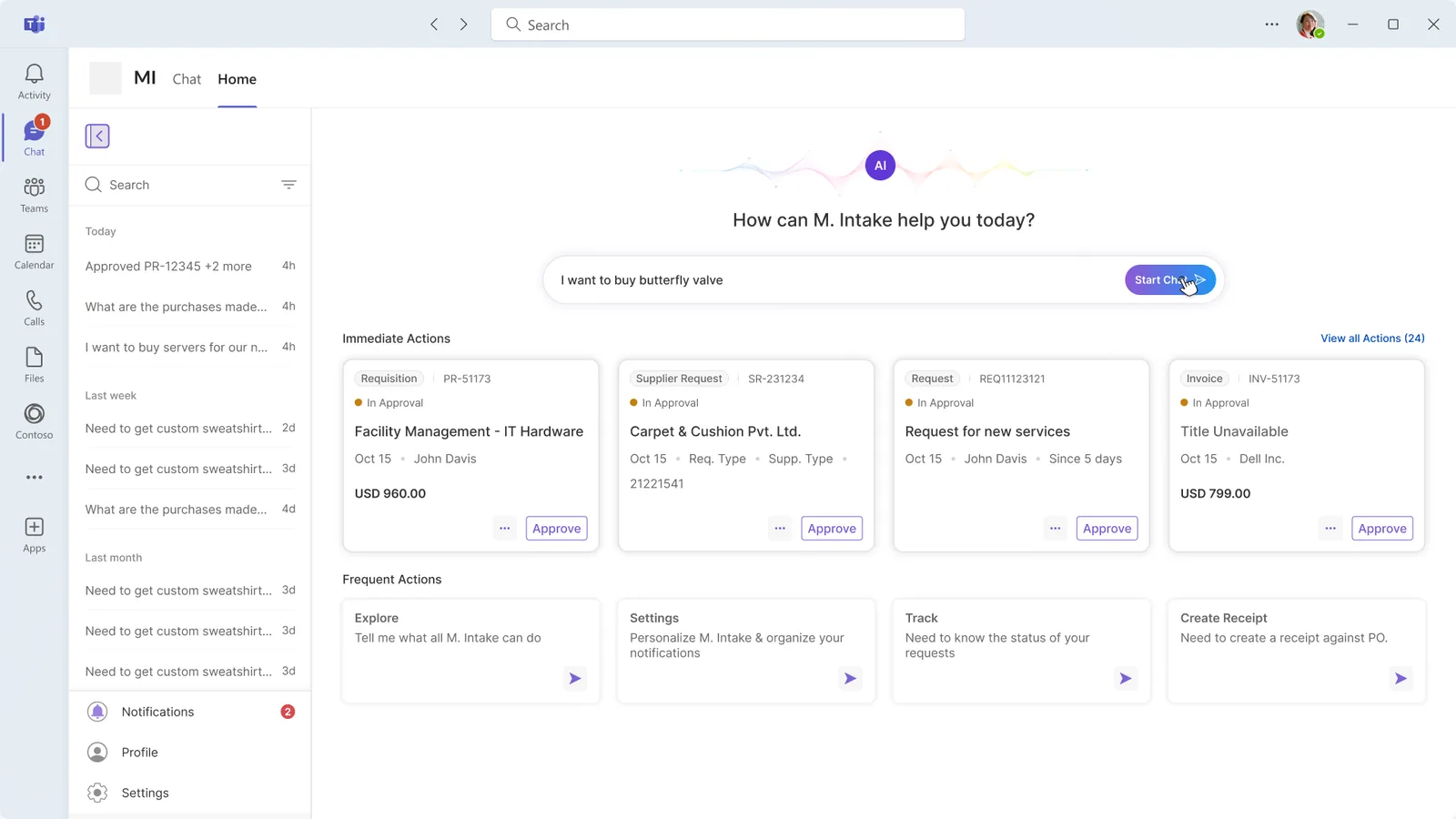
Procurement users already think in roles. "Who do I need?" is a question they can answer; "what can this AI do?" is not. The persona layer also quietly narrows scope — the buying agent isn't expected to assess supplier risk, which reduces what any single agent has to be right about.
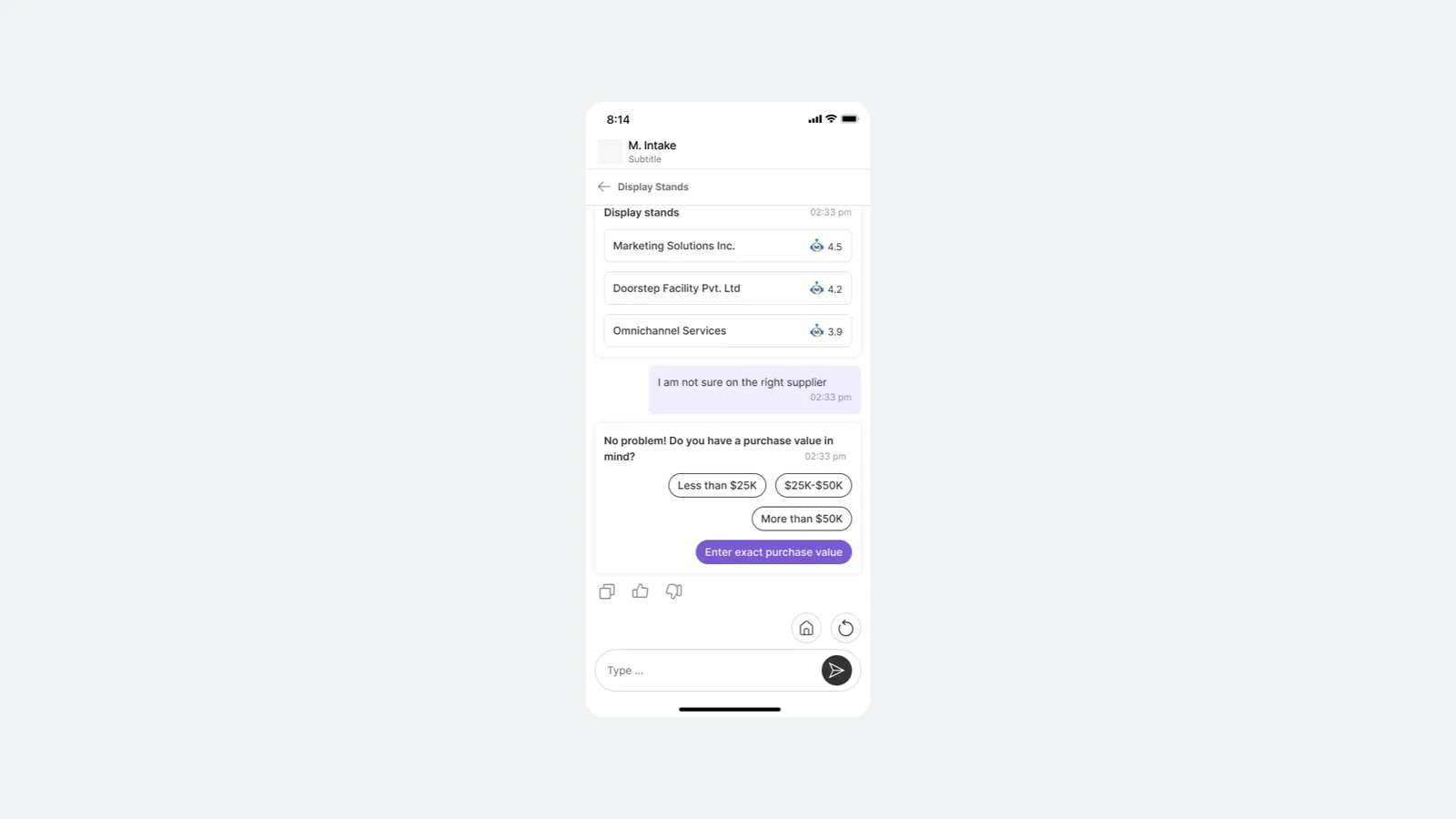
When someone replies "I'm not sure on the right supplier," the system doesn't error or re-prompt. It narrows: a clarifying question and bounded quick-reply chips. Not knowing is treated as an ordinary place to be.
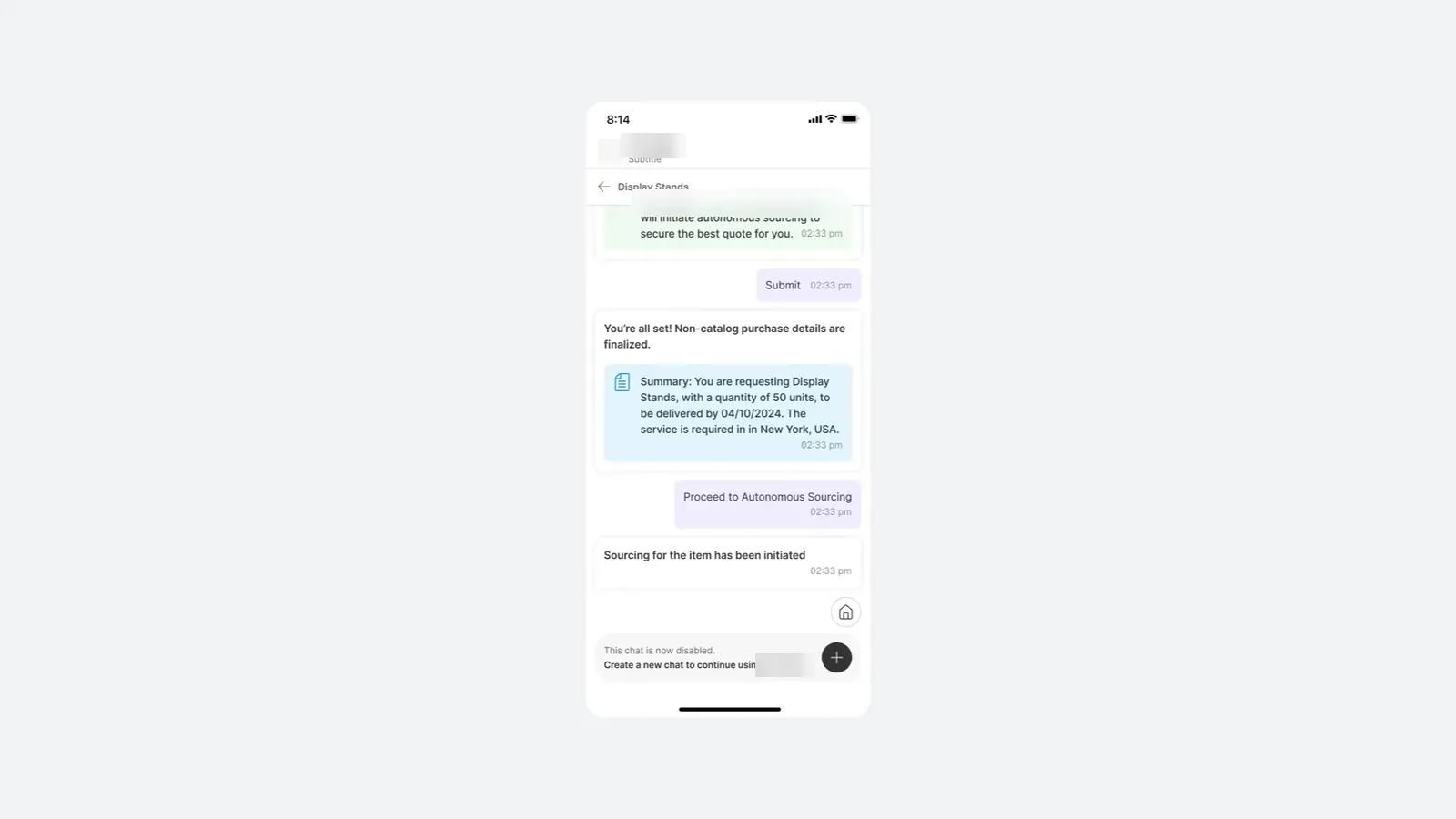
An open input box implies the agent is still listening. When a flow concludes, the input disables with a clear next step — because when it isn't listening, saying so is more honest than a blinking cursor.
Quick-reply chips replace typing wherever a decision is bounded. Entering a supplier name on a phone is a different problem from entering it on a laptop.
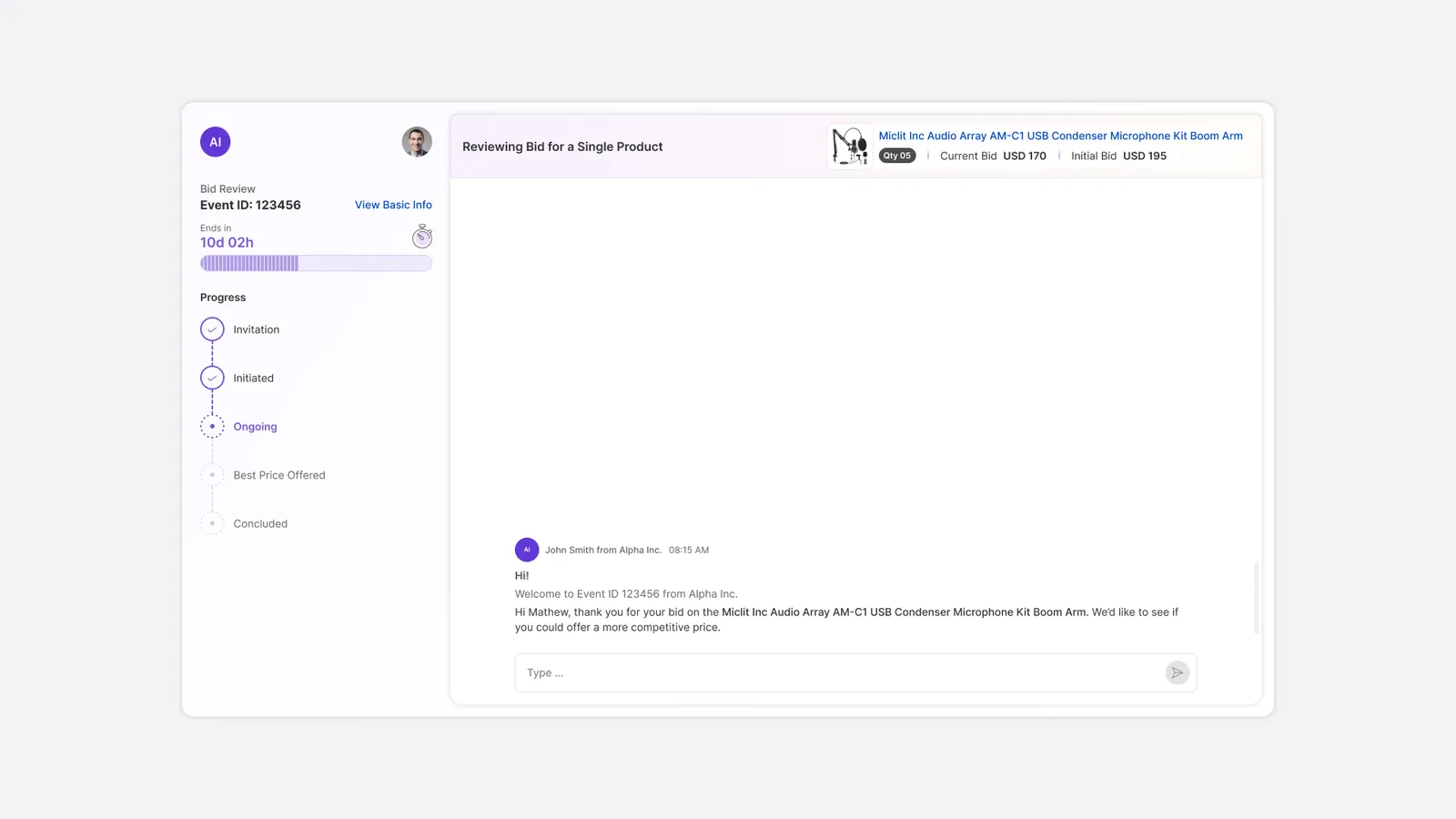
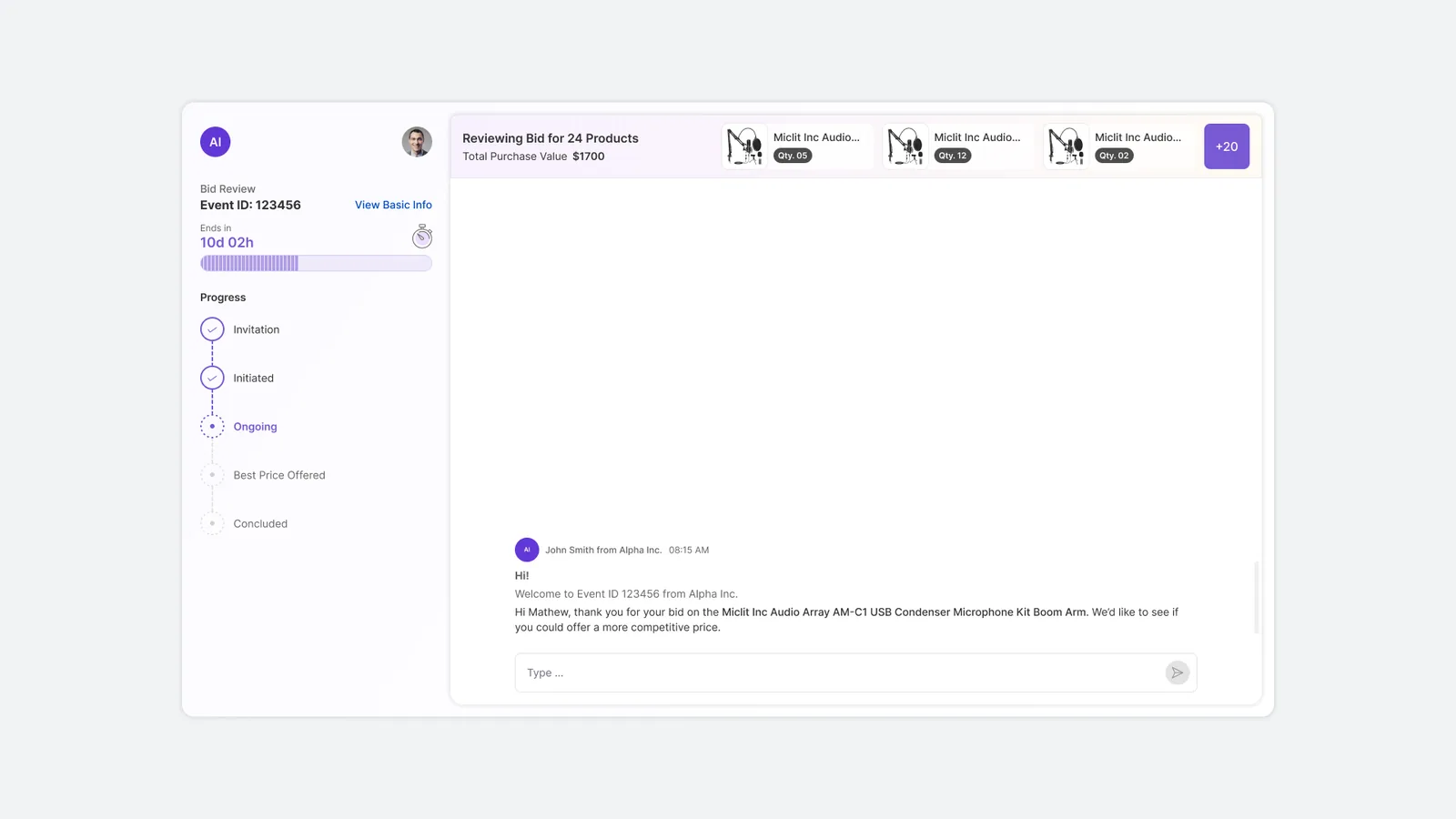
Supplier negotiation isn't a chat problem — it's a time-boxed event with a counterparty. That surface uses a countdown, a five-stage progress rail, and the bid values pinned in the header. It holds from a single item up to 24 products in one event.
Led a major part of rebuilding the legacy component library into a modern, production-ready Figma system — smart component variants, extensive Auto Layout, scalable design tokens, and written UI guidelines governing consistency across products.
Modernised the icon library into a unified style, then built an AI-assisted workflow that encodes the design system's rules: a designer types an icon name and gets back a conforming icon. Not using AI tools — building internal tooling that makes a system's constraints executable rather than documented.
Before the AI pivot, contributed to implementing dark theme across the suite — adapting screens, components and tokens for visual consistency and accessibility.
I use AI heavily in my own process — generation, exploration, first drafts. On this project it produced a proposal I accepted, and shouldn't have.
A flow ran five steps. The model proposed collapsing it to three by merging steps, reasoning that fewer steps is a better experience. On its face that's defensible advice — it's the kind of simplification a good designer might make.
It was wrong. The merge broke the navigation model underneath, and users ended up routed onto a different screen path than the flow intended. I caught it in my own review and reverted it.
So I use AI for generation and exploration, and keep structural decisions with a designer. That distinction isn't a limitation I work around — it's the reason the role still exists.
The company repositioned its entire Source-to-Pay suite around autonomous agents — spanning intake, sourcing, contracts, supplier management and procure-to-pay. The agentic layer had to sit across all of it.
Client and product names are withheld. Screens are representative and sanitised; all data shown is illustrative.